We do not document every change. We keep the moments that changed the product, the process or the way we think about what we are building.
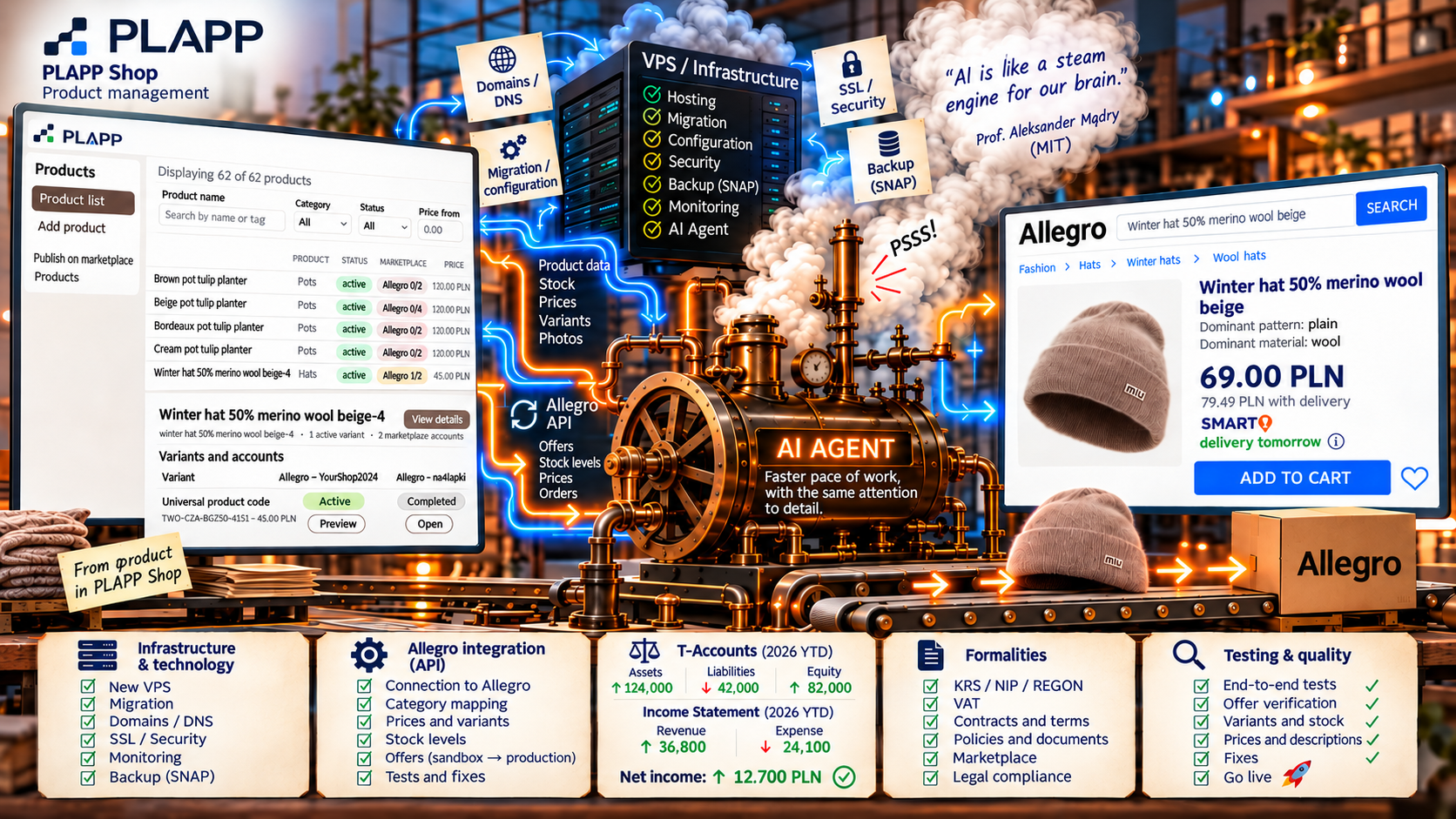
From sandbox to live Allegro. We did it!
On 26 October, we published our first live Allegro listing directly from PLAPP Shop — an important milestone for the project. 🎉
Just one listing? Behind it were weeks of API integration work, tests, fixes and, almost as a side quest, a “quick migration” to a new VPS. Production, as usual, had a few opinions of its own. 😄
We develop much of PLAPP with the support of AI agents. They help us move significantly faster, but they don't eliminate technical problems or replace business understanding, judgment and real-world verification.
Now comes the real test: will our beta tester at Twój Butik find this workflow useful enough to make it part of her everyday routine? The integration is still evolving, but we've taken our first step into real-world operation.
Lesson learned: AI can dramatically accelerate software development, but it cannot replace product ownership or testing with real users. A prototype proves something is possible; a product must prove it is useful.
Concept illustration. Financial figures and interface details are illustrative, not actual PLAPP financial results.Original LinkedIn story (in Polish) ↗
Some progress is invisible from the outside
For the last two weeks there was less to show from the outside, while quite a lot was changing underneath. In the sandbox, PLAPP Shop connected more of the marketplace flow: publishing offers, bringing orders back into the cockpit, handling returns and updating inventory.
This is still not a production integration, but the pieces are starting to behave like one process rather than a collection of separate features.
At the same time, the rights to the PLAPP website and platform were formally transferred to PLAPP sp. z o.o. A change of infrastructure provider then started another round of work: a new VPS, migration, security, backups, agent access, the tunnel and DNS.
AI can make parts of this work significantly faster, but it does not remove the need for patience, order and persistence. Some weeks end with a new screen. Others end with less chaos and stronger foundations.
And somewhere between the next checklists, another idea has already started to form. That one can wait. 🙂
Lesson learned: AI can accelerate engineering, but it does not remove the need for patience, persistence and careful foundations. Not every milestone is visible.
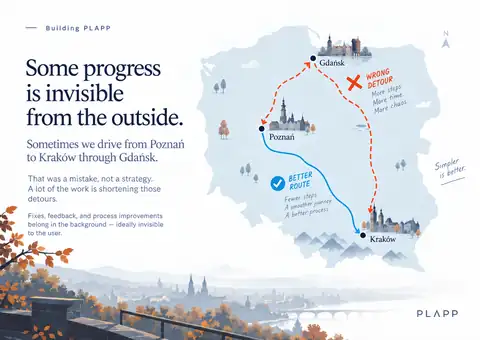
Sometimes you can get from Poznań to Kraków through Gdańsk. You will still reach the destination. The problem is that you will travel quite a few unnecessary kilometres along the way.
A lot of our recent work on PLAPP looks exactly like that: revisiting things that already work, gathering feedback, removing unnecessary steps and finding a simpler route to the same destination.
From the outside, almost nothing may appear to change. Inside, quite a lot does.
Lesson learned: the first working route does not have to be the best one. Sometimes you only see the shortcut after travelling the longer road.
Improve the process before automating it
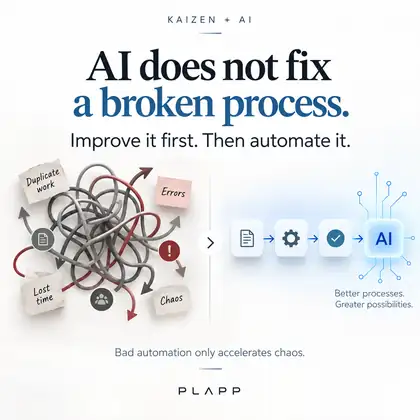
Automation does not always fix a process. Sometimes it only makes a badly designed process run faster. Before asking “how can we automate this?”, it is worth asking whether the step should exist at all.
Lesson learned: Kaizen is older than today’s AI wave, but the principle still holds: simplify first, accelerate second.